iBottle is an Australian-owned company that sells two tiers of portable hydrogen water bottles—the standard iBottle and the premium iBottle+—through its direct-to-consumer website. The company positions itself as "Australia's Most Trusted Hydrogen Water Bottle," citing over 20,000 customers and an average 4.9-star rating across 897 reviews. The product range uses PEM (proton-exchange-membrane) electrolysis technology, with the iBottle+ claiming lab-verified hydrogen concentrations of up to 4,000 PPB.
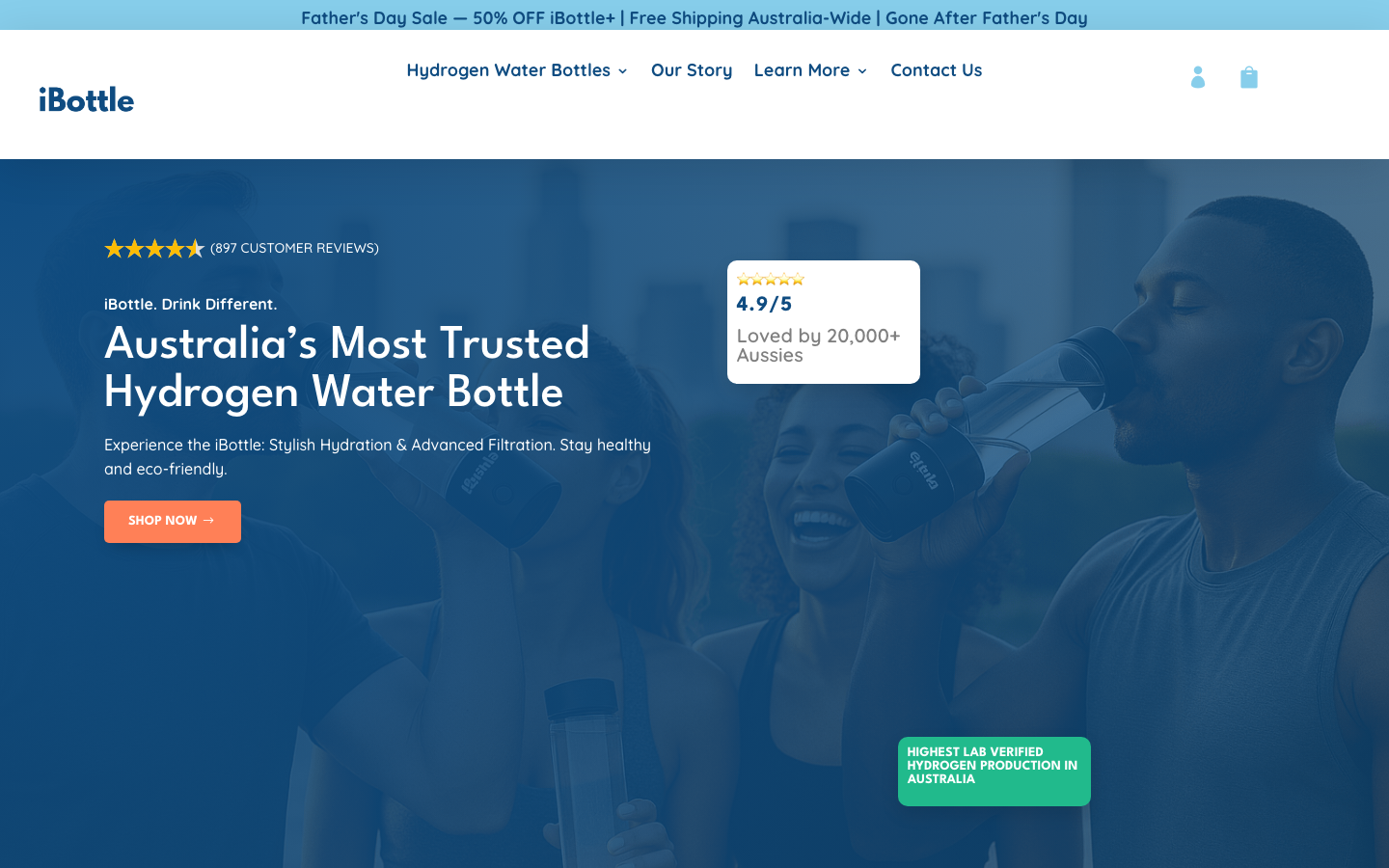
For H2 Wellness Hub, the relevant question is not whether portable hydrogen bottles exist—they are among the fastest-growing product forms in the global hydrogen-wellness market. The more useful question is what a high-concentration-claiming portable brand reveals about how consumer hardware companies navigate the gap between lab-measured peaks and real-world usage conditions.
Why this is a Cases item
Portable hydrogen water bottles occupy a specific position in the Hydrogen Wellness Industry. Unlike fixed hydrogen water machines or pre-packaged hydrogen water, portable bottles generate hydrogen on demand—and the consumer experience depends on variables that lab conditions do not replicate: water temperature, water mineral content, cycle frequency, battery charge level, and the time between generation and consumption.
iBottle's approach is worth examining because it illustrates several dynamics common to portable-hydrogen hardware brands:
- Concentration as primary differentiator: The iBottle+ claims up to 4,000 PPB (parts per billion) of dissolved hydrogen—positioned as "Australia's highest verified concentration from any hydrogen water bottle." Concentration claims are the most visible competitive metric in portable-hydrogen marketing, but they raise immediate questions about measurement conditions, time-from-generation, and what "verified" means in practice.
- Lab-verification as credibility signal: iBottle links to a published lab report on its website—a transparency practice that is uncommon in the portable-hydrogen category. This positions the brand favorably relative to competitors who make concentration claims without any third-party backing. However, a single lab report under controlled conditions does not necessarily predict consumer-experience performance.
- Celebrity-endorsement amplification: The homepage features references to Joe Rogan and Gary Brecka—public figures with large wellness-audience followings. Celebrity endorsement amplifies consumer reach but also raises the stakes for claim accuracy, because public figures' audiences may interpret endorsements as clinical validation rather than marketing partnership.
What the product presence does not establish
iBottle's lab-verified concentration data is a company-referenced commercial fact. It does not constitute TGA therapeutic approval, clinical validation of the health claims made on the homepage (immune-system improvement, longevity, cognitive enhancement, disease risk reduction), or independent verification that consumers will achieve the claimed concentrations under real-world usage conditions.
The product pages list extensive health-benefit categories—including immune-system support, longevity, energy, cognitive function, and disease-risk reduction—supported by references to "1,400 scientific studies." These are category-level research citations applied to a specific product, which creates a communication dynamic where general hydrogen-water literature is presented alongside product-specific marketing in ways that may blur the evidence boundary for consumers.
Three practical questions for the portable-hydrogen category
1. Do lab-verified concentrations translate to consumer experience?
A lab report typically measures hydrogen output under controlled conditions—specific water type, temperature, and cycle parameters. In daily use, consumers may use different water sources, temperatures, and usage patterns. Does iBottle disclose how its lab conditions relate to typical consumer use?
2. How does the brand handle health-claim boundaries under Australian law?
Under TGA and ACCC guidelines, therapeutic claims for consumer products require specific evidence standards. iBottle's homepage references disease-risk reduction, immune-system improvement, and cognitive benefits—language that approaches therapeutic territory. How the brand navigates these boundaries is a case study in Australian wellness-marketing compliance.
3. What is the replacement-part and service lifecycle?
Portable hydrogen bottles involve consumable components—glass kits, membranes, and seals. iBottle offers a replacement glass kit, suggesting awareness of product lifecycle. Does the brand provide clear information about membrane lifespan, replacement frequency, and how performance degrades over time?
How to use this case
For portable-hydrogen brands, iBottle illustrates both the credibility value of lab verification and the challenges of translating lab data into consumer-experience claims. For distributors evaluating Australian hydrogen products, the case highlights the importance of examining concentration-claim methodology and TGA-compliance posture. For industry observers, it is a snapshot of how celebrity endorsement, lab verification, and high-concentration claims interact in the portable-hydrogen segment.
iBottle company homepage
Company website · Product information and lab-verification claims. The source is linked for verification and context; the editorial analysis above is H2 Wellness Hub's independent industry interpretation.
Visit iBottle ↗