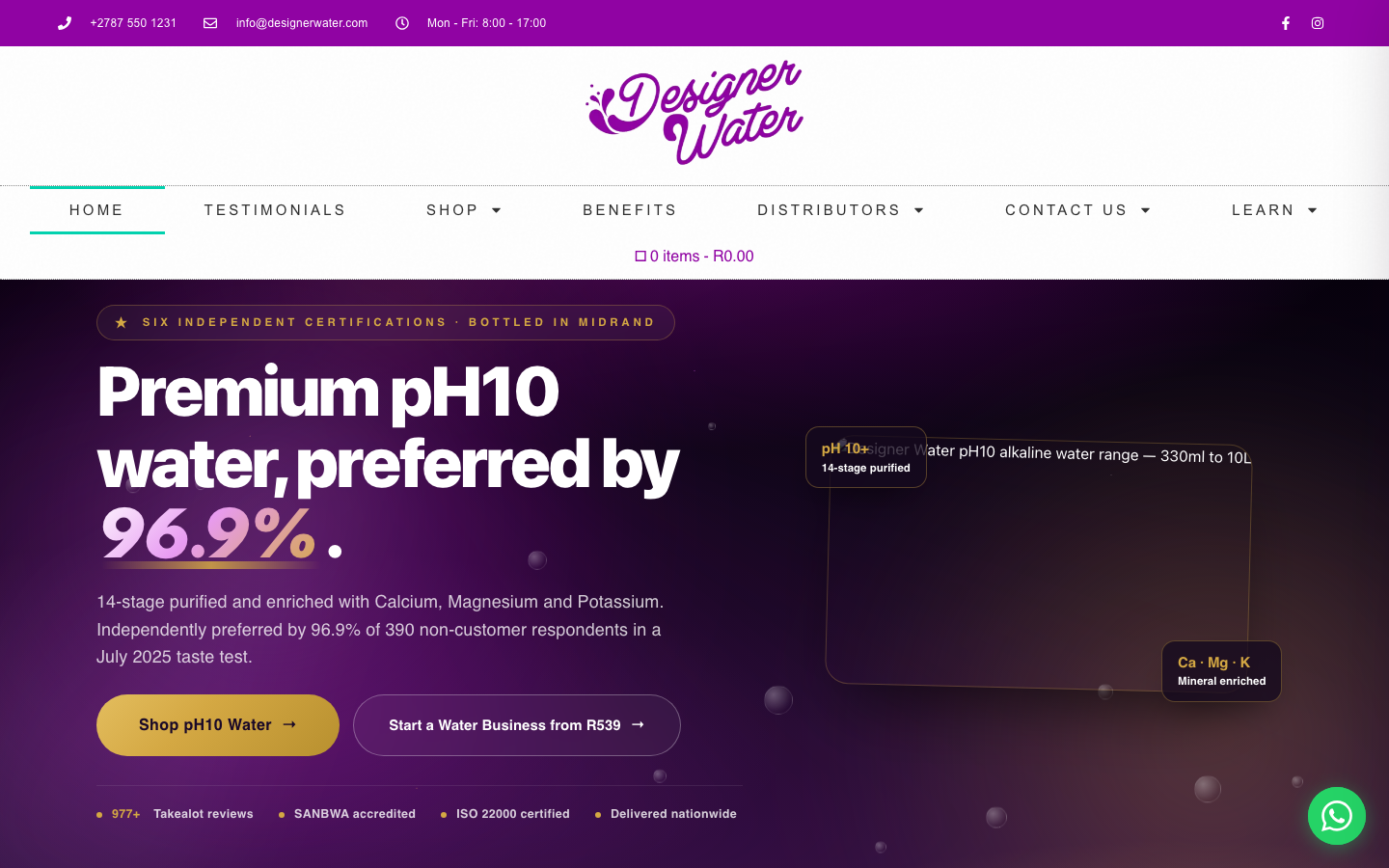
Designer Water offers hydrogen water products through its South African platform, positioning them within the country's premium bottled-water segment. South Africa has a well-established bottled-water market with strong competition at multiple price points, but hydrogen-specific water products remain a new concept for most consumers.
For H2 Wellness Hub, the relevant question is not whether South Africans buy premium bottled water—they do, and the market is competitive. The more useful question is what a hydrogen-water brand must overcome to introduce a novel product concept into a market where the premium-water space is already crowded and consumer education about molecular hydrogen is limited.
Why this is a Cases item
South Africa represents an underexplored frontier for the Hydrogen Wellness Industry. The country has a large urban consumer base with growing wellness awareness, a competitive bottled-water market, and regulatory frameworks through the South African Bureau of Standards (SABS) and the National Regulator for Compulsory Specifications (NRCS) that govern food and beverage products. A hydrogen-water brand entering this market must navigate both the novelty of the product concept and the established competitive dynamics of premium water.
Designer Water's approach is worth examining because it illustrates the specific challenges of hydrogen-water market development in an African context:
- Category novelty: Unlike markets in Asia where hydrogen water has decades of research visibility, South African consumers generally do not have a frame of reference for hydrogen water as a distinct product category. The brand must invest in category education before it can compete on product specifics.
- Premium positioning: South Africa's premium-bottled-water segment includes strong international and local brands. Hydrogen water must justify its premium positioning through clearly communicated differentiation—concentration, source water, or functional claims that consumers can evaluate.
- Distribution challenges: South Africa's retail landscape varies significantly between urban centers and broader distribution networks. A hydrogen-water brand must decide whether to target metropolitan specialty retail or pursue broader availability, each with different cost and education implications.
- Regulatory context: SABS and NRCS standards for beverages focus on safety, labeling, and quality. Hydrogen-specific standards do not yet exist, placing the burden of credible concentration claims on the brand's own testing and disclosure practices.
What the product presence does not establish
Designer Water's product availability is a commercial fact. It does not constitute SABS certification of hydrogen-water-specific claims, clinical validation of health benefits, regulatory approval beyond standard South African food and beverage requirements, or evidence that the product delivers different biological outcomes than other premium bottled-water products.
A company website with product descriptions serves a commercial function. It communicates the brand's positioning and intended value proposition. It does not, by itself, provide independently verified concentration data, source-water analysis, stability testing, or comparative information that would allow consumers to evaluate the product against category benchmarks.
Three practical observations
1. Emerging markets require category creation, not just product competition
In established hydrogen-water markets, brands compete on concentration, source, and packaging. In South Africa, the first task is creating consumer awareness that hydrogen water exists as a category. This requires a different marketing investment and communication strategy than competing in an established segment.
2. Premium water literacy is an asset and a constraint
South African premium-water consumers are familiar with evaluating water sources, mineral content, and brand positioning. This literacy can support hydrogen-water communication if the brand can connect hydrogen concentration to the evaluation framework consumers already use. But it also means consumers will apply the same scrutiny to hydrogen claims that they apply to other premium-water attributes.
3. Africa represents a long-term hydrogen-water growth vector
While current hydrogen-water market activity is concentrated in Asia, North America, and Europe, emerging markets like South Africa may represent significant long-term growth as wellness awareness expands. Early entrants like Designer Water are building category awareness that later competitors will benefit from.
How to use this case
For brands considering African hydrogen-water market entry, Designer Water's presence illustrates both the opportunity and the education investment required. For distributors evaluating South African hydrogen-water products, the case highlights the importance of understanding the local regulatory context and consumer-literacy landscape. For industry observers, it adds a data point to the developing picture of how hydrogen water is being positioned in emerging markets globally.
Designer Water hydrogen water products
Company website · Product information. The source is linked for verification and context; the editorial analysis above is H2 Wellness Hub's independent industry interpretation.
Visit Designer Water ↗